Exploring Collective Leadership in Complex Times
Today’s challenges cannot be solved by simple plans. This workshop with Teach For Austria focused on how collective leadership can enable change within complex systems.
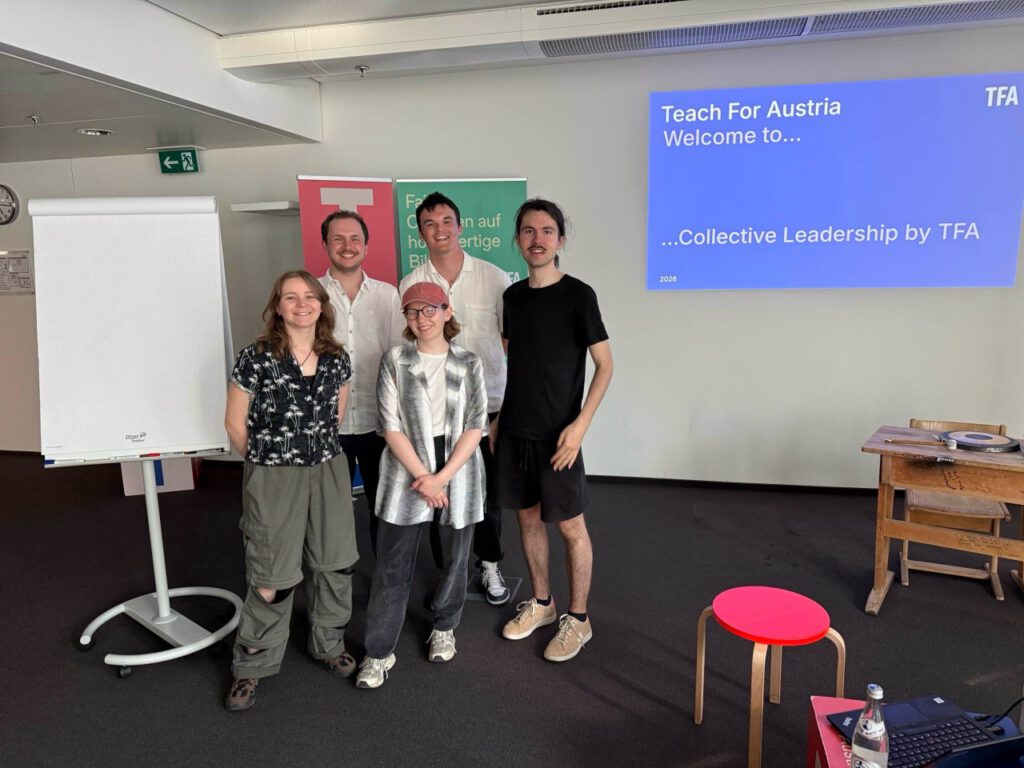
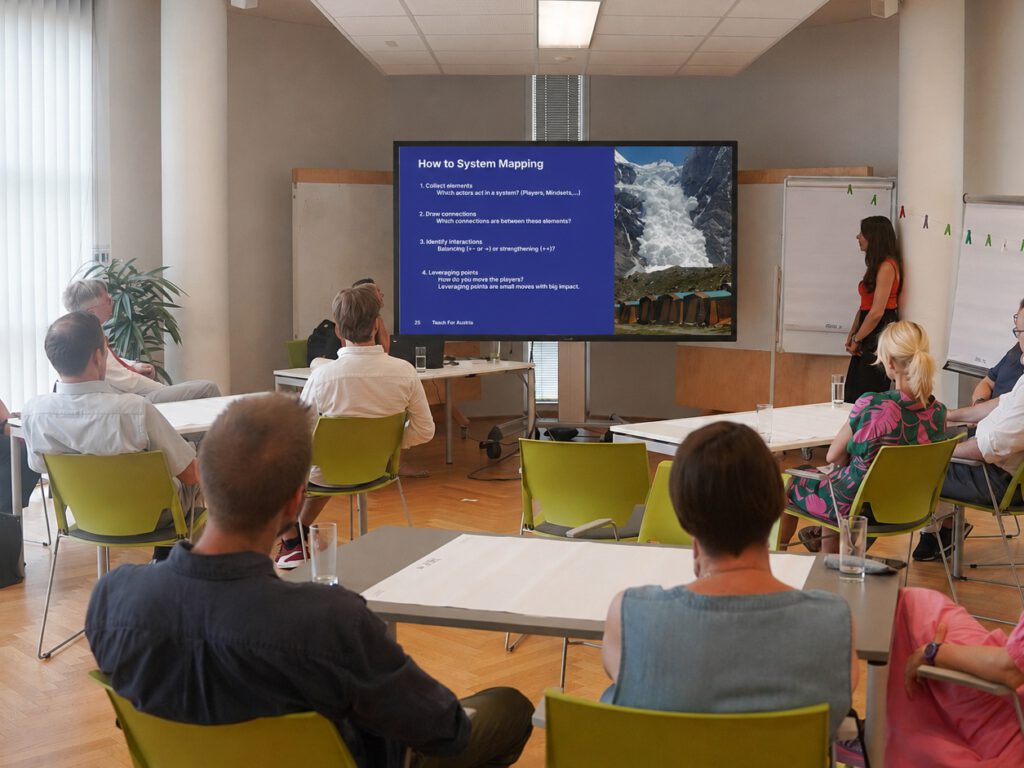
On a sunny afternoon this May, a small group of SEEP Master Club students came together at the Teach For Austria office for a workshop on Collective Leadership. The session invited us to reflect not only on our own leadership skills, but also on a bigger question: What kind of leadership is needed in times of complex global challenges?
The workshop was facilitated by Teach For Austria, an NGO working toward greater educational equity in Austria. Through its Social Leadership Programme, TFA brings committed graduates and professionals into schools as Fellows, especially in contexts where children face unequal educational opportunities. The connection to SEEP is also a personal one: several SEEP alumni have joined Teach For Austria as Fellows, carrying SEEP’s systemic perspective into educational practice.
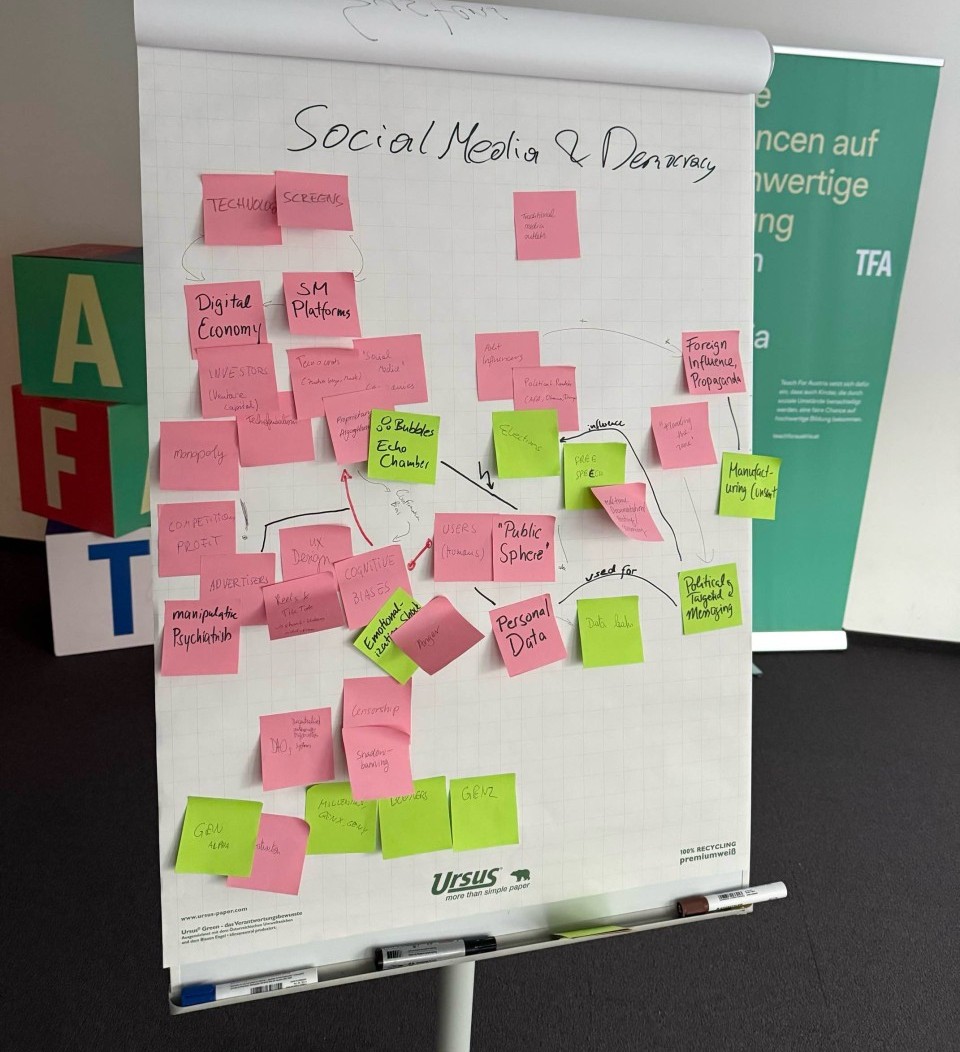
A central theme of the afternoon was systems thinking. As the workshop reminded us, global challenges are rarely isolated problems with linear solutions. They are shaped by many actors, feedback loops, assumptions, and power relations. Rather than trying to “control” systems, the task is to understand how they behave and where interventions might create meaningful change.
To practice this, participants created a system map around the topic “Social Media and Democracy.” Together, we identified actors, dynamics, reinforcing loops, and possible leverage points. The resulting map showed how issues such as platform business models, political polarization, personal data, echo chambers, foreign influence, targeted messaging, and public discourse are deeply interconnected. The exercise made visible how complex democratic challenges become when mediated through digital infrastructures.
The second part of the workshop focused on collective leadership: leadership that does not depend on formal authority alone, but emerges through shared responsibility, trust, relationships, and collaboration across different perspectives. This resonated strongly with the experiences in the room. Participants brought insights from very different contexts. From political movements to business teams and volunteer organizations. Sharing these experiences across worlds opened up a productive conversation about personal leadership styles, responsibility, uncertainty, and the challenge of creating change together.
Teach For Austria also introduced its approach of Teaching as Collective Leadership, which sees children as leaders, educators as learners, communities as sources of power, and educational work as systemic. These lenses offered a concrete example of how leadership can be practiced in everyday institutions. Not as top-down direction, but as an ongoing process of learning, listening, building relationships, and challenging root causes of inequality.
For the SEEP Master Club, the workshop was a reminder of why collective spaces matter. SEEP students often work on complex socio-ecological and political problems, but doing so requires more than analysis. It requires the ability to collaborate across difference, identify leverage points, and act with humility in systems we cannot fully control.
A big thank you to Clemens Bickel and Teach For Austria for hosting us and for creating a space where SEEP students could practice leadership for systemic change.